 By Ibtisam Virk
I have been running a tech blog for years. And I will be honest 2024 nearly broke my content strategy. I watched my carefully written articles disappear from Google overnight. Not because they were bad. Not because my SEO was wrong. But because AI Overviews started answering questions before anyone could click my link. Traffic dropped. Impressions stayed high. Clicks went nowhere. I tried adjusting keywords, rewriting meta descriptions, and refreshing old posts. Nothing worked. I was tracking rankings with tools built for a search world that no longer existed. Instead of asking ‘where do I rank,’ I started asking ‘is AI even reading my content?’ That question led me to ZipTie AI.
If you are reading this, you probably feel the same frustration. You write quality content. You do the keyword research. You follow SEO best practices. But your traffic is unpredictable. Your competitors are showing up in AI summaries while your articles sit invisible. Traditional tools like Ahrefs or SEMrush show you a position number, but they cannot tell you why AI search is ignoring your content. That gap is exactly why choose ZipTie AI search performance tool is a question more bloggers, content marketers, and SEO professionals are asking in 2026. In this complete guide, I will walk you through everything — what ZipTie AI is, why it works, how it compares, and whether it is right for you.
What Is ZipTie AI?
ZipTie AI is an AI-powered search performance tool. It helps you measure, track, and improve how your content shows up inside AI-generated search results.
It is not a traditional rank tracker. It does not just tell you if you are on page one. Instead, it focuses on something more important in 2026 whether AI systems like Google’s AI Overviews are reading and citing your content.
Think of it this way. Old SEO tools answer: where do I rank? ZipTie AI answers: will AI use my content to answer a real question?
| Quick Definition — ZipTie AI in One Sentence:ZipTie AI is a search performance platform built specifically to help content creators, marketers, and developers optimize their visibility in AI-powered search environments — not just traditional blue-link rankings. |
Who Should Use ZipTie AI?
ZipTie AI is built for anyone whose business depends on search traffic. Here is the exact audience it serves best:
| User Type | Why They Need ZipTie AI | Key Benefit |
| Bloggers & Content Creators | Traffic dropping despite good content | Know which posts get cited in AI answers |
| SEO Professionals | Clients asking about AI search ROI | Real-time AI visibility data for reporting |
| Digital Agencies | Managing multiple client websites | AI citation scores and content gap reports |
| SaaS Companies | Lots of content, unpredictable rankings | Keyword cluster tracking + decay alerts |
| Developers & Tech Teams | Building AI-ready content systems | Entity mapping + structural analysis |
| Product & Research Teams | Large document libraries hard to search | Natural language search across all files |
Why Choose ZipTie AI Search Performance Tool?
There are dozens of SEO tools available. So why choose ZipTie AI search performance tool over everything else? Here are the five core reasons.
1. Built for AI-Driven Search, Not Just Traditional SEO
Search engines have changed. Google now shows AI-generated summaries at the very top. These AI Overviews pull from trusted, well-structured content. If your article is not seen as a credible source, AI skips it completely.
Most SEO tools were built before AI Overviews existed. They track blue-link positions, not AI answer inclusion. ZipTie AI was designed from the ground up for this new reality. It monitors your AI search visibility in real time.
This is the single biggest reason to switch. Old tools cannot solve a new problem.
2. Smarter Performance Tracking
ZipTie AI does not just track rankings. It watches how your content performs inside AI systems over time.
It sends content decay alerts when your articles start losing AI visibility. It shows which keywords are appearing in AI summaries. It tracks entire keyword clusters, not just individual terms.
| What are some benefits of continuous performance tracking of AI models?→ Faster response to ranking drops before traffic fully collapses→ Better content adaptation as AI models update their behavior→ Ongoing optimization signals so you never go dark on performance→ Reduced traffic volatility across your entire content library |
3. ZipTie AI Overviews: A Unique Feature
ZipTie AI Overviews are AI-generated performance summaries that show you exactly what is happening with your content.
Each overview includes content gap detection, SERP volatility alerts, AI snippet tracking, and keyword cluster recommendations. You get actionable strategy delivered to you, not just raw data to interpret yourself.
No other tool packages this level of AI-specific insight into one summary view.
4. Works Better Than AI-Only Writing Tools
AI writing tools like Jasper or ChatGPT help you create content. That is where they stop.
ZipTie AI does the next step. After your content is written, it tells you if that content is ready to rank and be cited in AI search. Writing and optimizing are two different jobs. ZipTie AI handles the optimization side.
Use AI to write. Use ZipTie AI to make sure AI search can find what you wrote.
5. Privacy and Full Data Control
Your files and data stay under your control. ZipTie AI does not share your content with third parties.
This is critical for agencies managing sensitive client data and teams working on confidential research.
Key Features That Make ZipTie AI Stand Out
| Feature | What It Does | Who Benefits Most |
| Semantic AI Search | Understands meaning and intent, not just keywords | Content creators, researchers |
| Multiple File Support | Reads PDFs, Google Docs, Markdown, and more | Teams with large document libraries |
| AI Citation Scoring | Tells you how likely AI will cite your content | SEO professionals, bloggers |
| Content Decay Alerts | Notifies you when content starts losing AI visibility | SaaS companies, agencies |
| Entity Mapping | Maps entities to strengthen AI readability | Developers, technical SEO |
| Collaboration Tools | Highlight, comment, tag findings with your team | Digital agencies, product teams |
| Real-Time Search Speed | Instant results even across huge datasets | All users |
| Natural Language Interface | Ask questions in plain English — no tech skills needed | Beginners, content teams |
| ZipTie AI Overviews | AI-generated summaries with strategy and alerts | All users |
How Does ZipTie AI Work?
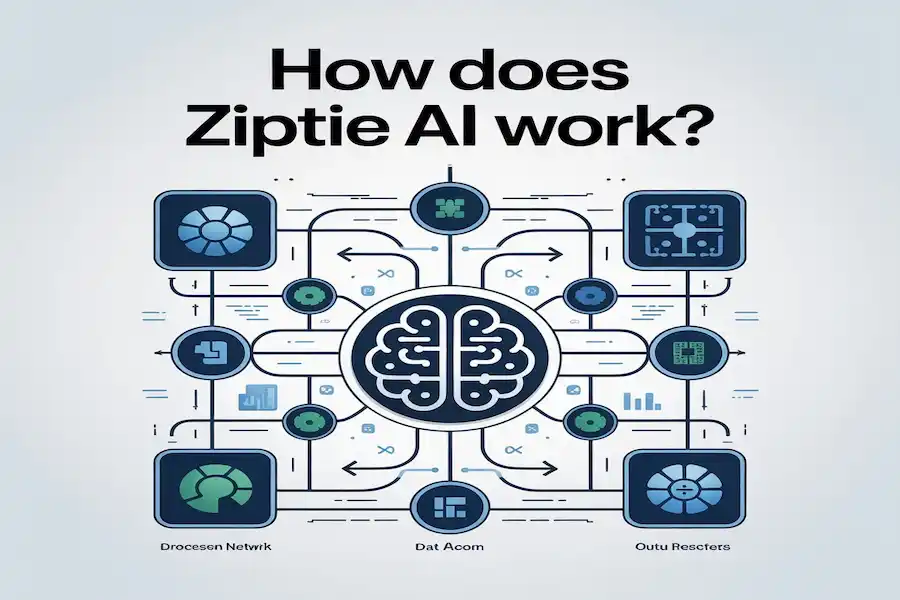
Getting started is simple. Here are the four steps:
1. Upload your data or connect sources like Google Drive or Dropbox.
2. ZipTie AI indexes your content automatically. It happens fast.
3. Type your question or keyword into the natural language search bar.
4. Review your results — summaries, AI citation scores, sources, and highlights.
That is it. Most users are up and running within a few minutes of signing up.
ZipTie AI vs Traditional SEO Tools
Here is an honest, side-by-side comparison of ZipTie AI against the tools most SEO professionals already use:
| Feature / Capability | Ahrefs | SEMrush | Surfer SEO | ZipTie AI |
| Traditional Keyword Ranking | ✓ | ✓ | ✓ | ✓ |
| AI Overview Tracking | ✗ | ✗ | ✗ | ✓ |
| Content Decay Alerts | ✗ | Limited | ✗ | ✓ |
| AI Citation Scoring | ✗ | ✗ | ✗ | ✓ |
| Entity Mapping Validation | Limited | Limited | ✓ | ✓ |
| Natural Language Search | ✗ | ✗ | ✗ | ✓ |
| AI Snippet Inclusion Tracking | ✗ | ✗ | ✗ | ✓ |
| GEO / AI-First Optimization | ✗ | ✗ | Partial | ✓ |
| Team Collaboration Tools | Limited | ✓ | Limited | ✓ |
| Free Plan Available | ✗ | Limited | ✗ | ✓ |
| Built for AI-First Search | ✗ | ✗ | Partial | ✓ |
| Note on Comparison Data:This table is based on publicly documented features of each tool as of early 2026. ZipTie AI’s AI-specific features (AI Overview tracking, citation scoring) are its primary differentiator — not a replacement for backlink analysis or on-page SEO features in Ahrefs or SEMrush. |
AI Readiness Scorecard — Is Your Content Ready for AI Search?
Before you even open ZipTie AI, check your content against this quick scorecard. This is what ZipTie AI evaluates automatically — but you can use this as a starting checklist right now.
| Check | What Good Looks Like | Status |
| Heading hierarchy is clear | H1 → H2 → H3, no skipped levels | Check yours |
| Direct answers appear under each heading | Answer in first 1-2 sentences after heading | Check yours |
| Paragraphs are short | 2-3 lines maximum per paragraph | Check yours |
| Entities are clearly defined | Brand, tool, person, concept names explained | Check yours |
| No keyword stuffing | Natural language, no repetitive keyword drops | Check yours |
| Schema markup added | FAQ schema, Article schema on key pages | Check yours |
| Content is regularly updated | No article older than 6 months without a review | Check yours |
| Internal links connect related topics | 3+ internal links per article minimum | Check yours |
If you checked fewer than 5 of these, ZipTie AI will flag those exact issues in your first audit. That is where to start.
Real-World Use Cases
For Bloggers and Content Creators
You write blog posts. But are they showing up in AI search answers? Most bloggers have no idea. ZipTie AI gives you a clear answer.
It shows which posts are getting cited in AI Overviews, which ones are decaying, and which topics have gaps you can fill. Instead of publishing and hoping, you publish and track.
For Product and Research Teams
Imagine thousands of research papers, product specs, and customer notes. Searching them manually wastes hours. ZipTie AI lets you ask questions in plain English and get direct answers from your own document library.
Product teams get instant context on user feedback, past issues, and feature documentation — all in one place.
For Digital Agencies
Agencies can now report AI search visibility to clients — something no competitor was offering before 2026. Show clients their AI citation readiness score, content gap improvements, and entity authority growth over time.
This makes your reporting more valuable than agencies still only showing a rank tracker screenshot.
For SaaS Companies
SaaS companies publish high volumes of content. Without AI tracking, rankings fluctuate unnoticed and AI Overviews quietly steal clicks from well-ranking articles.
ZipTie AI identifies which articles appear in AI summaries, which keywords are decaying, and sends proactive alerts to update content before traffic drops are felt.
What Are the Benefits of AI Search Optimization?
AI search optimization is about making your content readable, citable, and trustworthy to AI systems. The real benefits include:
| Benefit | What It Means for You |
| Visibility in AI-generated answers | Your content appears even when users don’t click regular links |
| Better intent matching | Attract more relevant visitors with higher conversion potential |
| Long-term ranking stability | Less dependent on daily rank fluctuations |
| Reduced backlink dependency | Strong content structure and entities can substitute for link volume |
| GEO advantage (Generative Engine Optimization) | Positioning your content for AI answer engines — the future of search |
| Authority signal growth | Consistent AI citations build topical trust over time |
What Common Mistakes Reduce AI Search Performance?
Many websites lose AI visibility without knowing the reason. Here are the top mistakes ZipTie AI helps you catch:
| Mistake | Why It Hurts AI Visibility | How ZipTie AI Fixes It |
| Keyword stuffing | AI models penalize unnatural repetition | Flags over-optimized pages automatically |
| Long dense paragraphs | AI cannot extract clean answers | Structural analysis detects extraction blockers |
| No direct answers under headings | AI skips content that buries definitions | Content structure scoring identifies the gap |
| Over-promotional tone | AI prefers neutral, informational language | Tone analysis flags marketing-heavy content |
| Poor heading hierarchy | AI parsing fails on broken H1/H2/H3 structure | Heading validation built into every audit |
| Missing schema markup | AI engines cannot confirm entity relationships | Schema validation check in developer workflow |
How to Use ZipTie AI Effectively
Here are seven practical tips to get the most value from ZipTie AI right from the start:
1. Track keyword clusters, not just single keywords — clusters reflect how AI groups topics.
2. Check AI snippet inclusion every week, especially after Google algorithm updates.
3. Act on content decay alerts immediately — do not wait until traffic is already gone.
4. Combine ZipTie AI with a technical SEO audit for a full-picture strategy.
5. Use question-based H2 and H3 headings in every article — AI extracts these first.
6. Make sure every entity in your content is clearly named and defined once.
7. Run a quarterly full-site audit — high-value pages need monthly monitoring.
ZipTie AI Pricing: What Does It Cost?
ZipTie AI offers a free plan for individuals and small teams. It is a great entry point with no commitment required.
Paid plans unlock more storage, advanced integrations, premium AI features, and agency-level reporting. Exact pricing details are available on the ZipTie AI website, and they update regularly.
| 💡 Pricing Takeaway: Free Plan Start here. Great for solo bloggers and small content teams. Paid Plans More storage, premium features, and integrations for agencies and SaaS companies. Value Perspective: Compared to an SEO consultant billing by the hour, ZipTie AI is a fraction of the cost for ongoing AI visibility tracking. |
Pros and Cons of ZipTie AI
| ✅ Pros | Details |
| AI search-focused from the ground up | Designed for AI Overviews, not retrofitted for them |
| Real-time performance alerts | Know instantly when content starts losing AI visibility |
| Natural language interface | No technical skills needed — just ask in plain English |
| Entity mapping included | Improves your AI citation probability directly |
| Team collaboration tools | Everyone works from the same data, in the same place |
| Free plan available | Start for free, upgrade only when you need to |
| Supports multiple file formats | PDFs, Google Docs, Markdown — all connected |
| ❌ Cons | Details |
| Learning curve on advanced features | Takes time to master AI citation scoring and entity workflows |
| English-first tool | Currently works best for English-language content |
| Requires initial setup time | You need to import data and connect your sources first |
| Better for intermediate+ users | Absolute beginners may find the analytics overwhelming at first |
| Pricing not public on all plans | You may need to contact for enterprise-level pricing |
FAQs
1. Why choose ZipTie AI search performance tool over traditional SEO tools?
Because traditional tools track blue-link rankings. ZipTie AI tracks AI overview inclusion, content decay, entity authority, and AI citation probability things Ahrefs and SEMrush cannot measure today.
2. What are the benefits of AI search optimization?
You get visibility inside AI-generated answers, better intent matching, long-term ranking stability, and less dependency on backlinks alone. In short, your content works harder without you writing more.
3. Does ZipTie AI work better than AI content generators?
For different reasons, yes. AI writing tools help you create content. ZipTie AI helps you rank and monitor it. They do different jobs and work best together.
4. Is ZipTie AI suitable for bloggers?
Absolutely. Bloggers benefit directly from knowing which posts appear in AI summaries, which ones are decaying, and which topics have gaps competitors have not filled yet.
5. Can ZipTie AI improve content visibility in AI overviews?
Yes. It tracks which content appears in AI-generated summaries and shows you the exact structural and semantic changes needed to improve inclusion.
6. What are the benefits of continuous performance tracking of AI models?
Faster response to ranking drops, better model adaptation as AI search behavior changes, ongoing optimization insights, and reduced traffic volatility across your content library.
7. Is ZipTie AI beginner-friendly?
Basic features are easy to start with. The natural language interface removes most technical barriers. Advanced features like entity mapping and citation scoring suit intermediate to advanced users.
8. Does ZipTie AI replace traditional SEO tools?
No. It complements them. Use Ahrefs or SEMrush for backlinks, technical audits, and on-page SEO. Use ZipTie AI for AI-specific performance tracking. Both together give you the full picture.
Closing Thoughts
After spending months testing AI search tools and rebuilding my own content strategy from the ground up, my conclusion is clear. The biggest mistake content creators are making right now is using yesterday’s tools to solve tomorrow’s problems. I spent too long refreshing keyword rankings in Ahrefs while Google’s AI Overviews quietly pulled traffic from my best-performing articles.
When I started using a tool built specifically for AI search performance, everything changed. I could see which content was getting cited. I could act on decay alerts before traffic dropped. I stopped reacting and started optimizing proactively. That shift, from rank-tracking to AI-visibility-tracking, is what ZipTie AI makes possible. It is not a magic fix. But it is the right tool for the search environment we are actually living in right now.
Whether you are a solo blogger trying to understand why your traffic dropped, or an agency director looking for a better client reporting story, why choose ZipTie AI search performance tool is a question with a straightforward answer: because AI search is the present and the future, and ZipTie AI is the only tool built specifically to help you win in it.
 Rabiya Maqbool