 By Ibtisam Virk
I have spent years studying the identity security space. I have never seen a threat move this fast. I began noticing the same story repeat in every fraud report I read. Contact centers were getting hit by voices that sounded real but were not. Deepfake fraud attempts had jumped by more than 1,300% in a single year (Pindrop VISR Report). I spoke with fraud managers at banks who told me their teams could no longer tell a real customer voice from a cloned one. Their tools were built for a different threat. That threat no longer exists. Today, AI creates the voice, AI runs the fraud, and AI scales it to thousands of calls per hour.
The Agentic AI, Pindrop, and Anonybit stack changes this completely. It is not a single product. It is a rethinking of how identity verification works when the attacker uses AI. I built this guide after reviewing official press releases, patents, verified case studies, and government documents. Every number here is sourced. Every claim is checked. If you are a CISO, fraud director, or CTO protecting customer-facing voice or video channels, this guide is written for you.
Why Identity Protection Is More Critical Than Ever
Your identity is not just your name. It includes your voice, your face, your fingerprint, and how you behave on a call. Fraudsters collect all of it.
They grab voice clips from LinkedIn, podcasts, or YouTube. They run those clips through AI cloning tools. Then they call your bank or insurer sounding exactly like you.
Here is what the data shows:
• Deepfake fraud attempts in contact centers grew 1,300%+ in 2024 Pindrop VISR Report 2025.
• AI drives 42.5% of all fraud attempts. Nearly 1 in 3 of those succeed Signicat, cited in Pindrop VISR.
• Contact centers face $44.5 billion in total fraud exposure projected for 2025 Pindrop VISR.
• Retail fraud rate: 1 in every 56 calls by end of 2025, up from 1 in 127 in 2024.
• Insurance companies saw a 475% surge in synthetic voice attacks. Banks saw 149%.
• Face swap attacks grew 704% in 2023. Mobile web injection attacks grew 255% iProov, cited in VISR.
Old tools stored voiceprints, passwords, fixed rules were not built for any of this. That is the exact gap that Agentic AI, Pindrop, and Anonybit fill.
What the Heck Is Agentic AI?
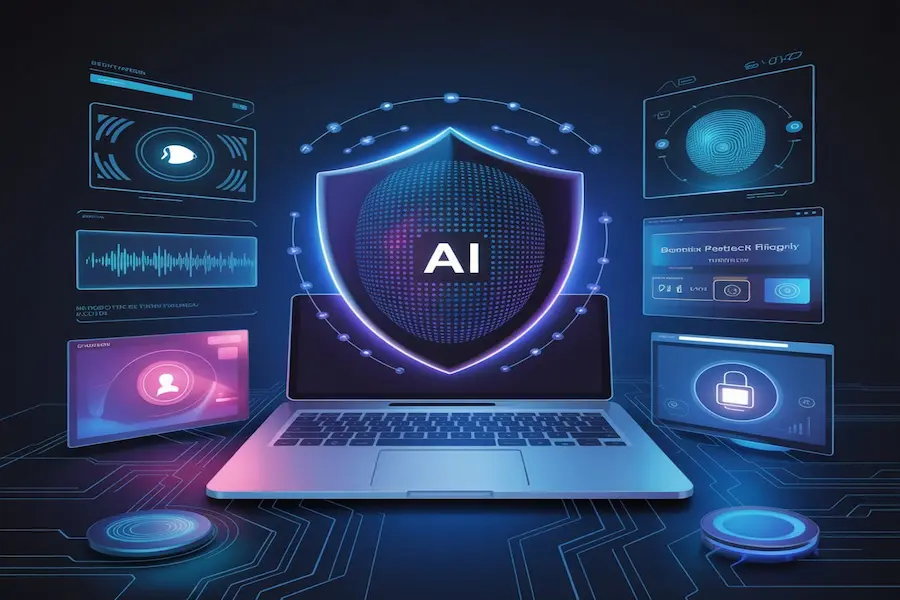
Agentic AI is an AI system that acts on its own. It does not wait for a human to give it instructions at every step. You give it . Agentic AI is different. You assign it a task. It plans, acts, monitors the result, and adjusts all on its own.
In contact center security, that means:
• It watches every call as it comes in.
• It runs fraud checks in real time.
• It makes a decision in under 200 milliseconds.
• It does all of this before a human agent ever answers the phone.
Deloitte predicts 50% of companies using generative AI will have active agentic systems in production by 2027. Over 80% of Fortune 500 companies are already running AI agents in some form.
But this creates a new security risk. AI agents need access to systems, databases, and APIs to do their work. That access can be abused. Most organizations have no clear answer to what happens when an AI agent gets compromised or makes a wrong decision.
Four Key Steps in the Agentic AI Process
Every Agentic AI system moves through four stages. Whether it is detecting fraud or verifying identity, the process is always the same:
1. Perception: Input is received by the agent. In voice security, this is the audio stream from a phone call or video meeting.
2. Reasoning: The agent processes what it received. It compares signals, calculates a risk score, and looks for fraud patterns.
3. Action: Based on its reasoning, the agent acts. It allows the call, blocks it, or requests additional verification from the caller.
4. Learning: After each decision, the agent updates its own understanding. New fraud patterns get added. The system becomes harder to fool over time.
These four stages happen in sequence, in real time, in milliseconds. No human team can screen thousands of simultaneous calls the way this system can.
What Is Autonomy in Agentic AI?
Autonomy means the AI acts without being told exactly what to do at every step.
A traditional security rule says: if the risk score is above 80, block the caller. That is a fixed rule. A human wrote it. The machine just follows it.
An autonomous agent does something more nuanced. It sees a risk score of 72. It also sees that Anonybit confirms a strong identity match. It knows from past data that this caller’s scores drop slightly when calling from this area code. So it allows the call with monitoring rather than blocking a real customer.
That context-aware judgment is autonomy in practice. Here is how autonomy levels work in real enterprise deployments:
• Low autonomy: The AI recommends an action. A human reviews and approves it.
• Medium autonomy: The AI handles low-risk decisions on its own. High-risk decisions go to a human.
• High autonomy: The AI handles almost everything end to end. Humans review outcomes, not individual calls.
Most enterprise fraud teams start at medium autonomy. As trust in the system builds, they shift routine decisions to high autonomy.
When Not to Use Agentic AI Pindrop Anonybit
Agentic AI is powerful. But it is not the right tool for every situation. Here is when you should not rely on it alone:
• High-stakes, irreversible decisions: If an AI agent approves a large wire transfer that cannot be reversed, any mistake is a disaster. Keep a human in the loop above a defined risk threshold.
• Thin data environments: Agentic AI learns from past examples. If your organization has very few fraud cases on record, the agent has nothing to learn from. Poor data means poor decisions.
• Regulated individual decisions: Denying a healthcare claim or blocking a benefits payment affects real people. Some regulators require human review for these decisions. Check your sector rules before automating.
• No audit trail in place: If your system cannot explain why it made a decision, you have a compliance problem. Never deploy agentic AI without full decision logging.
• Brand-sensitive interactions: Emotional conversations complaints, sensitive account issues need human empathy. Fully automated AI can damage the customer relationship in these moments.
The best deployments use Agentic AI for fast, high-volume, pattern-based decisions. They keep humans in the loop for exceptions.
What Is Pindrop?
Pindrop is a voice security company based in Atlanta, Georgia. It was founded in 2011 by Dr. Vijay Balasubramaniyan, Dr. Paul Judge, and Dr. Mustaque Ahamad.
Pindrop does one thing better than any other tool: it tells you in real time whether the voice on a call is a real human or an AI-generated clone.
How It Works
Pindrop analyzes how sound behaves in the physical world. A real human voice has specific acoustic properties the way air moves through lungs and a throat, the natural variations in pitch and timing, the way room acoustics affect speech. An AI-cloned voice cannot perfectly replicate all of these. Pindrop detects what is missing.
Pindrop Pulse for Meetings
This is Pindrop’s real-time product for video environments. It works inside Zoom, Microsoft Teams, and Cisco Webex. It gives every participant a live liveness score during the call.
Verified Performance Numbers
• Up to 99% accuracy detecting synthetic audio Biometric Update, November 2025.
• Less than 1% false positive rate.
• Outperformed all competitors by 40 percentage points in independent NPR deepfake detection tests.
• Ranked #1 in the ACM MM Deepfake Detection Challenge 2025 for video deepfake detection.
• Included in Time Magazine’s top inventions.
• Protects 7 of the top 10 US banks.
Healthcare Expansion (February 2026)
Pindrop expanded into healthcare in February 2026. It reports 99.2% accuracy when liveness detection combines with voice authentication in healthcare settings. In one deployment, a large US health payer used Pindrop to contain a coordinated attack targeting 1,200 accounts and prevented up to $18 million in potential fraud exposure.
What Is Anonybit?
Anonybit is a biometric identity platform co-founded in 2018 by Frances Zelazny.
Problem It Solves
Most organizations store biometric records fingerprints, face scans, voice prints in a central database. That database is a high-value target. One successful breach exposes every customer’s identity permanently. You cannot issue a new fingerprint the way you issue a new password.
How Anonybit Works
Anonybit breaks each biometric record into many small encrypted pieces. It stores those pieces across separate environments in a distributed cloud network. No single environment holds a complete record. If one environment is breached, the attacker gets only a fragment not enough to reconstruct or use the identity.
Verification never requires rebuilding the full record. It uses two cryptographic methods:
• Multi-Party Computation (MPC): Verification runs across multiple separate cloud environments at the same time. No single party ever handles the full biometric data.
• Zero-Knowledge Proof (ZKP): The system confirms an identity match without revealing the actual biometric data to anyone.
Identity Bound Agents
Frances Zelazny calls this approach identity-bound agents. Every action taken by an AI agent is tied to a verified human identity confirmed through this process. No AI agent can act without that confirmed link.
Supported Biometrics and Integrations
• Supports: face, voice, iris, and palm biometrics.
• Integrates with: Microsoft Entra and PingOne DaVinci.
• Recognized as a Privacy Prism Paragon in October 2025 alongside Apple and the FIDO Alliance. Only 3 vendors out of 230+ evaluated received this distinction.
How Agentic AI Pindrop Anonybit Work Together
Each technology covers one layer of the problem. Together, they form a three-step security check that runs in the background of every call.
Here is how it works when a customer calls a bank to request a wire transfer:
Step 1 — Check the Voice (Pindrop)
The moment the call connects, Pindrop starts listening. It analyzes the acoustic properties of the voice without asking the caller to do anything. It checks whether the voice carries the natural physical signals of a real human.
Within the first two seconds, Pindrop produces a liveness score between 0 and 100.
Step 2 — Check the Identity (Anonybit)
At the same time, Anonybit checks the caller’s identity. It reaches across its distributed network, runs a match across the separate fragments in parallel, and confirms whether this is the right person without ever reconstructing the full biometric record.
Step 3 — Make the Decision (Agentic AI)
The Agentic AI receives both scores and reasons through the full picture:
• Both scores pass: The call continues normally. The caller never knows a check happened.
• Voice score drops due to noise, identity confirmed: A push notification goes to the caller’s phone. They confirm with Face ID or fingerprint. Takes about 10 seconds. Call continues.
• Voice flagged as synthetic: The call is blocked or escalated to a human agent immediately.
The full three-step process completes in under 200 milliseconds. Real customers notice nothing. Fraudsters do not pass.
Why Traditional Voice Biometrics Fail in 2026
Legacy voice biometrics store a voiceprint at enrollment and match it to future calls. That worked before voice-cloning tools existed.
Today, a convincing clone takes only seconds. And central biometric databases are prime targets for large-scale breaches.
| Feature | Legacy Voice Biometrics | Agentic AI + Pindrop + Anonybit |
| Data Storage | Central database — one breach exposes all | Distributed fragments — no complete record anywhere |
| Deepfake Detection | Matches stored voiceprint — clones pass | Analyzes live acoustic properties — catches clones |
| Response Time | 30+ seconds; needs human review | Under 200ms; fully automated |
| Scalability | More calls = more staff needed | Scales automatically |
| GDPR/HIPAA | Central storage = breach reporting risk | Privacy-by-design — no central record to breach |
| User Experience | Security questions, PINs, wait times | No friction for confirmed identities |
| Fraud Adaptation | Fixed rules criminals learn to bypass | Context-aware reasoning that updates itself |
Attacks This Stack Defends Against
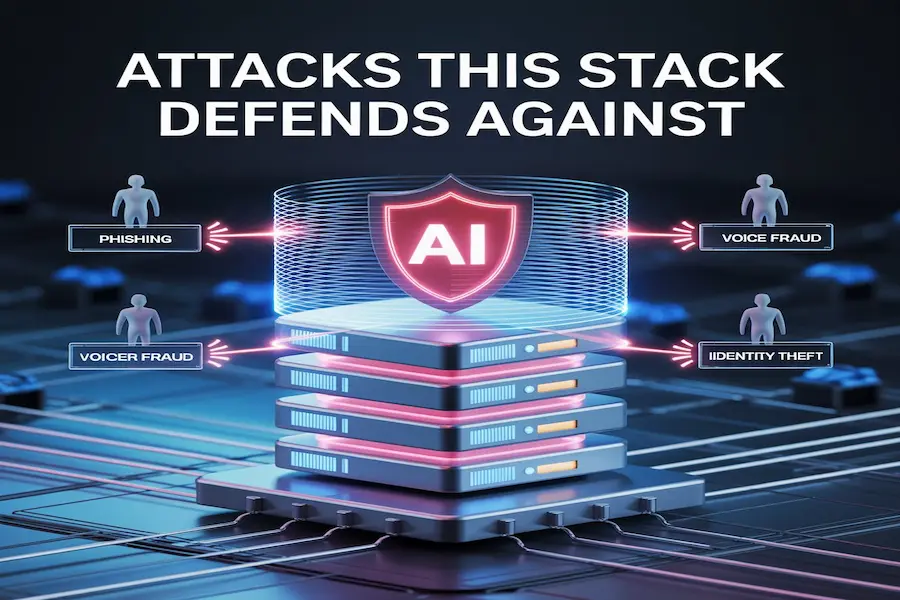
• Deepfake voice cloning: AI-cloned voice used to impersonate a customer. Pindrop detects the missing natural acoustic signals.
• Biometric database breach: Hackers target a central biometric database. With Anonybit, no complete record exists to steal.
• Face swap attacks: Real-time video tools overlay a fake face on a live call. Grew 704% in 2023. Pindrop Pulse detects this.
• Mobile web injection: Fake biometric data injected into an authentication pipeline. Grew 255% in 2023. Anonybit’s distributed design eliminates the single injection point.
• AI agent impersonation: A malicious AI agent pretends to be a legitimate system. Anonybit’s identity binding ties every action to a verified human.
• Deepfake job candidate fraud: Applicants use AI tools to pass video interviews as a different person. Pindrop Pulse detects this in Zoom, Teams, and Webex.
• Executive voice fraud: A CFO’s cloned voice used to authorize transactions. Pindrop Pulse catches this in real-time executive meetings.
• Spoofing-as-a-Service: Platforms that rent voice spoofing tools online. The combined stack defeats spoofed credentials at both the voice and identity layers.
Broader Security Ecosystem
Pindrop and Anonybit do not work alone. These are the key vendors in the same space. Understanding where each one fits helps you build a complete defense:
BioCatch — Behavioral Biometrics
BioCatch tracks how users behave on a device typing speed, mouse movement, scroll patterns, and over 3,000 other behavioral signals per session. Even if a criminal has your login credentials, they cannot replicate how you naturally use a device. BioCatch detects the difference.
• Analyzes 16.1 billion user sessions per month across 555 million users.
• Used by 3 of the 4 largest US banks by assets.
• $185M+ yearly in recurring revenue.
• Named top vendor in QKS Group’s 2025 SPARK Matrix for Behavioral Biometrics.
• Where it fits: BioCatch covers post-login behavior on digital channels. Pindrop covers voice and video channels. Together, they protect every customer touchpoint.
Authsignal — Adaptive Authentication Orchestration
Authsignal is a drop-in authentication platform. It handles passwordless login, passkeys, and adaptive multi-factor authentication. Security and product teams set authentication policies through a no-code rules engine no engineering required.
• Named Rising Star in KuppingerCole’s 2025 Leadership Compass for Passwordless Authentication.
• Launched native passkey authentication for ServiceNow contact center workflows in October 2025.
• Unveiled the world’s first palm and crypto retail payment at NRF 2026 (with Tools for Humanity and Qualcomm).
• Where it fits: Authsignal decides when to challenge a user. Pindrop and Anonybit provide the verification signals that power those challenges.
AuthenticID — Document and Biometric Identity Verification
AuthenticID verifies government-issued IDs, detects counterfeit documents, and matches a live selfie to an ID photo all automated.
• Over 99% accuracy in counterfeit ID detection.
• Reviews 2,000+ computer vision models per ID check.
• Accessible in 240 countries and areas globally.
• ISO/IEC 27001, SOC 2 Type 2, HIPAA, and GDPR compliant.
• Acquired by Incode Technologies in August 2025. Combined entity now serves 8 of the top 10 US banks.
Where it fits: AuthenticID handles onboarding verifying who you are when you first open an account. Pindrop and Anonybit protect every interaction after that.
Arkose Labs — Bot Detection and Attack Economics
Arkose Labs makes fraud economically unattractive. Its goal is not just to block attacks but to make running them too expensive to be worth doing.
• Launched Arkose Titan in January 2026 a unified platform combining bot detection, device intelligence, email intelligence, API security, and behavioral biometrics.
• Uses sixth-generation adaptive challenge technology that defeats bots, AI automation, and human fraud farms.
• Clients include Microsoft, Meta, Roblox, and two of the top 3 US banks.
Where it fits: Arkose Labs protects the front door blocking fake account creation and credential stuffing before authentication begins. Pindrop and Anonybit handle identity verification downstream.
Astrix Security — AI Agent and Non-Human Identity Security
Astrix focuses on securing the identities that AI agents use to access systems. These are called Non-Human Identities (NHIs) API keys, service accounts, and access tokens. They outnumber human employees by 100 to 1 in most enterprise environments. And 99% of them sit outside traditional identity management systems.
• Discovers every AI agent and NHI in an organization’s environment automatically.
• Identifies excessive permissions and abnormal agent activity.
• Deploys agents with least-privilege, time-limited credentials through its AI Agent Control Plane.
• Raised $85 million total including a strategic partnership with Anthropic.
• Recognized in Fortune 2026 Cyber 60 ranking
Where it fits: If Anonybit binds identities at the human level, Astrix does the same at the machine level securing every credential AI agents use to operate.
Apono — Zero Standing Privilege for AI Agents
Apono builds on a principle called Zero Standing Privilege. No user, service account, or AI agent should have permanent access to anything. Access should be granted only when needed, and revoked the moment the task is done.
• Grants Just-in-Time, Just-Enough-Access based on role, risk, and operational context.
• Access is automatically revoked when a task ends.
• Raised $34 million in Series B in November 2025. Total funding over $54 million.
• Clients include Intel, Hewlett Packard Enterprise, and Monday.com.
• Reduced standing privileges by 94% in documented deployments.
Where it fits: Apono controls what AI agents are allowed to do in your environment making sure agentic AI cannot cause damage beyond its intended scope.
Benefits of the Agentic AI Pindrop Anonybit Stack
For Security and Fraud Teams
• Up to 99% accuracy detecting synthetic audio with less than 1% false positives.
• No central biometric database means no central target for attackers.
• Full audit trail for every security decision required for NIST and EU AI Act compliance.
• Fraud detection adapts to new patterns automatically.
For Customers
• No passwords, PINs, or security questions for verified callers.
• Background checks of identity happen seamlessly
• Biometric data is never stored in one location that can be breached.
For the Business
• HealthEquity reported 90%+ reduction in voice fraud after deploying Pindrop February 2026.
• A large US health payer prevented up to $18 million in fraud exposure using Pindrop.
• Scales automatically across millions of calls without adding headcount.
• Privacy-by-design meets GDPR and HIPAA compliance requirements by default.
• Identity binding reduces legal exposure under new AI agent regulations.
Who Should Deploy This? Industries That Need It Most
Banking and Financial Services
• Deepfake attempts at banks grew 149% in 2024.
• 7 of the top 10 US banks already use Pindrop.
• High-value transactions over voice make this stack a baseline requirement.
Insurance
• 475% surge in synthetic voice attacks in a single year Pindrop VISR.
• Fraudulent claims triggered by deepfaked policyholder voices.
• Pindrop detects the fake voice before any claim reaches a human agent.
Healthcare
• Pindrop launched healthcare product in February 2026.
• 99.2% accuracy when liveness detection combines with voice authentication.
• HealthEquity: 90%+ fraud reduction confirmed by Ajit Gaddam, Head of Fraud, AI and Trust Platforms.
• HIPAA compliance built into Anonybit’s architecture by design.
Human Resources and Recruiting
• Deepfake job candidates are an emerging enterprise threat documented in Pindrop VISR Report.
• Applicants use AI tools to look and sound like a different person during video interviews.
• Pindrop Pulse detects this inside Zoom, Teams, and Webex in real time.
Government and Defense
• NIST launched AI Agent Standards Initiative on February 17, 2026.
• Specifically addresses how AI agents identify themselves and get authorized.
• Organizations deploying this stack are already aligned with where federal standards are heading.
Case Studies: Real Results
HealthEquity — Healthcare Fraud Prevention
HealthEquity is a US-based health savings account provider. After deploying Pindrop, they reported a 90%+ reduction in voice fraud. Every call is screened automatically with no added friction for legitimate customers. Confirmed by Ajit Gaddam in Pindrop’s February 2026 healthcare press release.
Large US Health Payer — $18 Million in Prevented Losses
A large US health payer used Pindrop to contain a coordinated fraud attack targeting 1,200 accounts. The attackers used AI-generated voices to access and change patient benefits. Pindrop identified the synthetic voices in real time. Up to $18 million in potential fraud exposure was prevented. Knowledge-based authentication would not have caught this.
Top US Banks
Seven of the top 10 US banks protect their contact centers with Pindrop. Pindrop has passed $100 million in annual recurring revenue a clear indication of broad adoption across the financial sector.
What Happens When the System Gets It Wrong?
No system is perfect. A real customer calling from a loud environment a busy street, an airport may receive a lower liveness score because the audio signals are harder to read.
This is a false positive. A real person gets flagged as suspicious. Here is how the Agentic AI handles it without blocking the customer:
1. The voice score drops due to environmental noise.
2. Anonybit confirms the distributed identity match is strong.
3. The Agentic AI sends a push notification to the customer’s registered phone.
4. The customer confirms with Face ID or fingerprint. Takes about 10 seconds.
5. The call continues normally.
No fraud passes through. A cloned voice has no matching Anonybit identity. No real customer is permanently blocked.
NIST and the EU AI Act: Why Compliance Demands This Stack
NIST AI Agent Standards Initiative (CAISI)
NIST rolled out its AI Agent Standards Initiative on Feb 17, 2026. It is specifically researching how AI agents establish their identity and get authorized to take actions. Most AI agents running today have no verified identity. They can be impersonated, compromised, or used fraudulently and there is often no clear record of what they authorized.
Anonybit’s identity-binding approach directly answers this. Every agent action is tied to a confirmed human identity. Organizations using this stack already have the audit trail structure NIST is moving toward.
EU AI Act — Full Enforcement August 2, 2026
The EU AI Act comes into full force in August 2026. It does not yet clearly define how multi-agent AI systems are held accountable when something goes wrong.
Anonybit’s identity binding fills this gap. Every agent action is tied to a verified human. This creates a clear accountability chain that satisfies what regulators need.
The Accountability Gap
• Only 14.4% of organizations launch AI agents with full security approval Gravitee, 2026.
• More than 80% of Fortune 500 companies already use active AI agents.
• This gap is exactly what the Agentic AI, Pindrop, and Anonybit stack closes.
Step by Step Implementation Guide for CTOs
1. Connect Pindrop to your telephony or video platform: Use SIPREC for call centers or WebRTC for web-based voice. For video, Pindrop integrates natively with Zoom, Teams, and Webex. Most deployments complete this in one to two weeks.
2. Enroll customers in Anonybit: One-time biometric enrollment. Data is distributed immediately. No central record is created. The SDK integrates with existing apps and portals.
3. Set Agentic AI risk thresholds: Common starting point above 80: allow. 60 to 80: monitor with logging. Below 60: step-up or block.
4. Build your step-up verification flow: Configure what happens when extra confirmation is needed a push notification to the registered phone with Face ID or fingerprint confirmation.
5. Connect to your SIEM for audit logging: Route all Agentic AI decision logs into your Security Information and Event Management system for full compliance documentation.
6. Run a 30-day pilot on a limited call volume: Test on a subset first. Review false positive rates. Adjust thresholds. Then scale up. Most enterprise go-lives happen within six to eight weeks of contract signing.
Next Generation Identity Protection with Agentic AI
Voice cloning tools are getting cheaper every month. The fraud threat is not leveling off. Here is where the technology is heading:
• Quantum-resistant design: Anonybit’s distributed architecture does not rely on a single encrypted record. Advances in quantum computing that could break traditional encryption do not expose the full biometric because no full record exists.
• Agent-to-agent authentication: NIST’s CAISI initiative is researching what happens when two AI agents interact with each other. Anonybit’s identity-binding, Astrix Security’s AI Agent Control Plane, and Apono’s Zero Standing Privilege framework are all directly relevant to this challenge.
• Continuous verification: The next step is checking identity throughout a session not just at the start of a call, but at every sensitive action. BioCatch already applies this principle to digital banking. Pindrop and Anonybit are moving toward the same model for voice and biometric channels.
The Agentic AI, Pindrop, and Anonybit stack is the foundational layer for enterprise identity security in the years ahead.
FAQs
What is Agentic AI in cybersecurity?
Agentic AI is an autonomous AI system that perceives input, reasons about risk, takes security actions, and learns from outcomes all without waiting for human instructions. In identity security, it orchestrates tools like Pindrop and Anonybit and makes decisions in real time.
What are the four stages of the Agentic AI pathway?
Perception the agent receives input (a voice call or video session). Reasoning it analyzes the input and calculates a risk score. Action it decides to allow, step up, or block. Learning it updates its understanding from the outcome of each decision.
What is autonomy in Agentic AI?
Autonomy means the AI acts based on context and judgment not just fixed rules. Autonomy levels range from low (AI recommends, human approves) to high (AI handles routine decisions end to end).
When should you not use Agentic AI?
Do not rely on Agentic AI alone for high-value irreversible decisions, thin-data environments, regulated individual decisions, situations without an audit trail, or emotionally sensitive customer conversations.
How does Pindrop detect deepfake voices?
Pindrop analyzes the physical acoustic properties of a voice signals that AI-generated audio cannot fully replicate. It achieves up to 99% accuracy detecting synthetic audio with less than 1% false positive rate, and outperformed all competitors by 40 percentage points in independent NPR tests.
Is Anonybit GDPR compliant?
Yes. No complete biometric record is ever stored in one place. This meets GDPR’s data minimization and privacy-by-design requirements. Anonybit was recognized as a Privacy Prism Paragon alongside Apple and the FIDO Alliance in October 2025.
What industries benefit most from this stack?
Banking, insurance, healthcare, HR and recruiting, and government. Any organization verifying customer identity over voice or video channels should evaluate this stack.
Conclusion
After years of studying the identity security and fraud prevention space, my conclusion is clear. The traditional approach to voice authentication is no longer adequate against AI-generated threats. I have reviewed Pindrop’s VISR reports, studied the Anonybit patent filings, tracked the HealthEquity results, and followed what NIST is building with its AI Agent Standards Initiative.
The pattern is consistent. Organizations that have deployed the Agentic AI Pindrop Anonybit stack are stopping fraud that their previous systems could not detect. The ones still relying on stored voiceprints and central biometric databases are running a known risk every single day.
If you are responsible for security, fraud, or technology at an organization that handles customer identity over voice or video, this is not something you can put off until 2027. The EU AI Act enforcement arrives in August 2026. NIST is building the standards that will define how AI agents must operate.
The tools in this guide Pindrop for voice liveness, Anonybit for distributed biometric identity, Agentic AI for autonomous real-time decisions, and the broader ecosystem of BioCatch, Authsignal, AuthenticID, Arkose Labs, Astrix Security, and Apono represent where enterprise identity defense stands today. Not every organization needs all of these tools. But every organization handling customer identity in 2026 needs to understand this space. Start with the core three. Build from there.