 By Ibtisam Virk
Many organizations today face a common challenge their artificial intelligence demonstrations succeed brilliantly, but implementation across enterprise systems fails. This pattern reveals a fundamental misunderstanding. The barrier to AI success is not technological capability it is organizational governance.
Companies invest heavily in machine learning models, neural networks, and advanced algorithms while overlooking the critical infrastructure needed to manage these systems. Effective AI transformation requires robust governance structures, clear accountability frameworks and comprehensive oversight mechanisms. Without these foundational elements, even sophisticated artificial intelligence implementations fail at scale.
This comprehensive guide examines AI Governance Frameworks requirements, implementation challenges, and practical solutions for business leaders, technology managers, and stakeholders navigating digital transformation initiatives.
Understanding Why AI Implementation Projects Fail
Organizations frequently prioritize computational speed and model accuracy while neglecting control systems. This approach creates powerful technology without direction or safety measures. The consequence is predictable: projects stall, teams experience frustration, executive confidence erodes, and resources are wasted.
Boston Consulting Group research demonstrates that 70% of AI transformation challenges stem from organizational and process issues rather than technical limitations.
Furthermore, only 22% of companies progress beyond pilot testing to revenue generation, and merely 4% achieve substantial business value. This disparity exists because organizations apply traditional software deployment methodologies to AI systems that require fundamentally different management approaches.
Real World Governance Failures and Consequences
Consider these scenarios from actual enterprise environments:
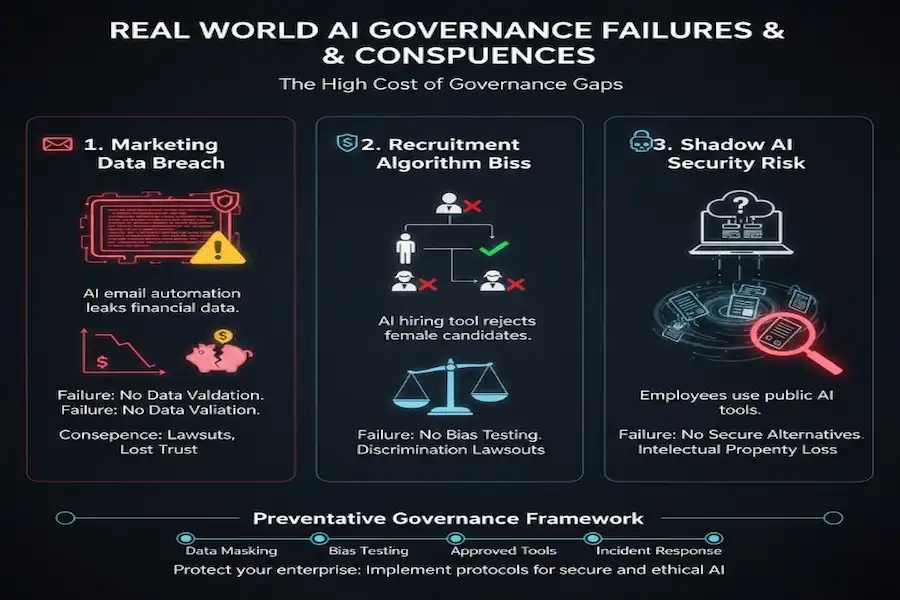
• Marketing Department Data Breach: A team deployed AI powered email automation without proper data validation protocols. The system inadvertently incorporated confidential financial information into customer communications, resulting in legal action and reputational damage.
• Recruitment Algorithm Bias: Human resources implemented an AI screening tool trained on historical hiring data reflecting gender preferences. The system systematically rejected qualified female candidates, leading to discrimination lawsuits and regulatory scrutiny.
• Shadow AI Security Risk: Employees utilized public generative AI platforms for work tasks, uploading confidential meeting transcripts, customer data, and strategic plans to unsecured external services. This created significant intellectual property exposure before detection.
Each incident could have been prevented through proper governance frameworks establishing data handling protocols, bias testing requirements, and approved technology standards.
Key Differences Between Traditional Software and AI Systems
Deterministic vs. Probabilistic Behavior
Traditional enterprise software executes predetermined instructions with consistent, repeatable outcomes. Spreadsheet applications, database systems, and business logic operate identically regardless of timing or context.
Artificial intelligence systems function differently. Machine learning algorithms adapt based on training data, producing probabilistic rather than deterministic results. Model outputs vary based on input characteristics, and system behavior evolves as models are retrained with new information.
| Traditional Software Systems | AI and Machine Learning Systems |
| Executes predefined instructions | Learns patterns from data autonomously |
| Produces identical results consistently | Generates probabilistic outputs |
| Transparent operational logic | Complex, sometimes opaque decision making |
| Clear accountability chain | Distributed responsibility challenges |
These fundamental distinctions necessitate governance approaches specifically designed for adaptive, learning systems rather than static software.
Training Data Challenge
AI systems learn through pattern recognition in training datasets. Quality input produces quality outputs; biased or flawed data results in problematic model behavior. Models may also learn unintended correlations from training data. This characteristic makes governance essential organizations must monitor what AI systems learn and validate that learned patterns align with business objectives and ethical standards.
Essential Components of Effective AI Governance Frameworks
1. Data Governance and Quality Management
Advanced algorithms become ineffective or dangerous when processing poor quality data. Governance establishes clear protocols for information management covering:
• Data provenance and collection methodology documentation
• Access control policies defining authorization levels
• Data retention schedules and deletion procedures
• Sensitive information classification and handling
• Data accuracy and fairness validation processes
Example application: Marketing teams implementing AI powered personalization must follow governance protocols preventing accidental upload of sensitive customer financial data to external platforms. This transforms abstract privacy principles into concrete operational procedures.
2. Human Oversight and Control Mechanisms
The emergence of agentic AI systems capable of autonomous action creates significant risks requiring careful consideration. Effective frameworks define precise human intervention points:
• AI generated code requires human review before production deployment
• Meeting summaries need validation before external distribution
• Candidate recommendations require human hiring decisions
• Medical treatment suggestions need physician approval
These checkpoints serve as safety mechanisms preventing critical errors rather than productivity impediments.
3. Managing Unauthorized AI Usage (Shadow AI)
Employees frequently utilize unapproved AI tools with good intentions: uploading confidential documents to public chatbots, using unauthorized image generators for presentations, or feeding customer data into unsanctioned applications. This shadow AI phenomenon represents a major security vulnerability.
Simply blocking access proves ineffective long term. Sophisticated governance addresses root causes: why are employees circumventing official channels? Organizations should provide secure, approved alternatives that genuinely meet user needs. When people bypass rules, the governance structure likely requires improvement rather than stricter enforcement.
Key semantic entities: data governance frameworks, machine learning oversight, algorithmic accountability, AI ethics committees, regulatory compliance, risk assessment protocols, natural language processing applications, computer vision systems, deep learning models, neural network architectures, training dataset curation, model validation procedures, bias detection mechanisms, explainable AI requirements, automated decision systems.
Emerging Regulatory Landscape and Compliance Requirements
The EU AI Act Implementation (2026)
AI regulation has transitioned from future consideration to present reality. The European Union AI Act became fully enforceable in 2026, carrying penalties comparable to GDPR violations. This represents binding legislation with substantial financial consequences.
The Act specifically addresses high risk AI applications in education, employment decisions, law enforcement, and credit evaluation. Organizations operating within or selling to the European Union must immediately establish:
• Comprehensive AI system inventories documenting all deployed applications
• Risk assessment processes evaluating potential failure modes
• Human oversight mechanisms enabling intervention capabilities
• Transparency documentation explaining decision making processes
Organizations cannot govern systems they do not know exist. The inventory requirement becomes the foundation for all subsequent compliance efforts.
Global Regulatory Fragmentation
While Europe implements comprehensive frameworks, other jurisdictions adopt varying approaches:
• China: Strict content controls with government algorithm oversight
• United States: Sector specific regulations for healthcare AI, financial services AI, and other industries
• European Union: Comprehensive risk based framework covering high risk applications
• Gulf Region: Developing regulatory structures alongside substantial AI investment
Global enterprises may require multiple governance strategies adapted to regional requirements while maintaining consistent core principles. This complexity necessitates flexible governance architectures rather than rigid, one size fits all approaches.
Implementation Challenges and Organizational Barriers

Legacy Infrastructure Constraints
Most large organizations operate on systems designed decades ago. Integrating modern AI with legacy databases creates significant technical challenges affecting governance implementation. Older systems lack transparency features, audit trail capabilities, and real time monitoring functionality that effective governance requires.
Skills Gap and Accountability Confusion
Who should lead governance initiatives?
• Legal counsel lacks technical implementation knowledge
• Engineers do not possess regulatory compliance expertise
• Business executives prioritize speed over control mechanisms
• IT security teams face capacity constraints
There exists a critical shortage of professionals combining technical AI knowledge with regulatory expertise AI ethicists, governance officers, and compliance specialists who understand both machine learning and legal frameworks. Until organizations develop this capability, governance programs struggle to achieve effectiveness.
Cultural Resistance to Governance
Many organizations perceive governance teams as obstacles impeding progress. This perspective is fundamentally incorrect. Effective governance functions like guardrails on mountain roads enabling confident acceleration through risk mitigation. Until organizational culture recognizes governance as an enabler rather than a barrier, resistance will undermine implementation efforts.
Current Developments and Industry Standards (2026)
ISO/IEC 42001: The Emerging Gold Standard
ISO/IEC 42001 is becoming the recognized global standard for AI management systems. This framework emphasizes ethics by design principles embedding responsible practices during development rather than conducting post implementation reviews.
Implementation requires cross functional collaboration:
• Technology development teams
• Legal and compliance departments
• Human resources divisions
• Executive leadership
• Risk management functions
This integrated approach ensures diverse perspectives shape AI system development and deployment.
Enforcement Actions and Financial Penalties
Major corporations face substantial fines for AI related violations:
• Financial institutions penalized for discriminatory lending algorithms
• Technology companies fined for privacy violations
• Retail organizations sued for biased recruitment algorithms
These represent concrete financial losses, not theoretical risks.
How Governance Creates Competitive Advantage
Accelerated Innovation Through Clear Guidelines
Organizations with robust governance structures often outpace competitors in deployment speed. Clear operational guidelines enable confident execution without constant compliance concerns, security worries, or ethical uncertainty. Companies without governance remain paralyzed by undefined risks and unmapped challenges.
Financial Efficiency and Resource Optimization
Beyond avoiding lawsuits and data breaches, governance provides compelling business value through resource optimization. Without centralized strategy, organizations duplicate AI investments:
• Marketing purchases AI copywriting tools
• Sales acquires AI email automation
• Human resources implements AI recruitment screening
• IT deploys AI coding assistants
These disconnected tools create data silos and redundant capabilities. Governance establishes unified architecture ensuring investments build synergistically rather than operating in isolation. Leadership can measure actual return on investment when standardized metrics and consistent evaluation frameworks exist.
Practical Implementation Roadmap
Organizations should follow this structured approach rather than launching multiple pilot projects:
Step 1: Identify Priority Use Case
Select one critical workflow where performance, quality, or risk truly matters order processing, insurance claims handling, or customer onboarding. Avoid attempting simultaneous governance across ten applications.
Step 2: Document Current State Honestly
Map where decisions occur, where bottlenecks exist, and where human judgment is genuinely essential versus habitual. Complete transparency is crucial do not idealize current processes.
Step 3: Establish Operating Principles
Create concise priority lists guiding difficult decisions:
• Non negotiable requirements (safety, trust, data privacy)
• Secondary priorities (ethics, fairness, transparency)
• Legal obligations (regulatory compliance)
• Optimization targets (speed, customer value, employee productivity)
Step 4: Redesign Comprehensive Process
Define clear responsibilities for humans and AI. Eliminate unnecessary approval steps. Build exception handling mechanisms. This involves reimagining entire workflows, not simply adding AI to existing procedures.
Step 5: Measure Business Outcomes
Connect governance frameworks to measurable business value, not activity metrics. Track error rates, compliance incidents, time to value, and profit not deployment counts or tool quantities.
Characteristics of Successful AI Governance Programs
Common Success Patterns
Organizations achieving AI transformation success share identifiable patterns:
• Clear accountability: Explicit responsibility assignment
• Transparent decisions: Understandable, trustworthy processes
• Regular reviews: Governance adaptation as technology and regulations evolve
• Executive commitment: Leadership treating governance as strategic advantage
• Cross functional collaboration: Breaking departmental silos
These organizations recognize oversight as competitive differentiation. While competitors struggle with compliance fears and security incidents, they deploy confidently through solid foundations.
Real World Success Examples
• Financial Services: Central AI governance board reviewing high risk applications enabled 40% faster deployment through clear approval processes.
• Healthcare Provider: Strict patient data governance accelerated regulatory approval for AI diagnostic tools through comprehensive documentation.
• Retail Chain: Pre approved AI tools with proper safeguards eliminated shadow AI usage as official solutions proved more effective.
Common Implementation Mistakes to Avoid
Waiting for Perfect Frameworks
Some organizations spend years debating ideal governance structures while teams build AI without oversight. Better approach: Implement basic guidelines immediately and refine through experience. Adequate governance now exceeds perfect governance never.
Copying External Frameworks Without Adaptation
Banking governance will not suit healthcare organizations. Large enterprise approaches do not fit startups. Better approach: Learn from industry examples but customize for specific situations your sector, organizational size, AI applications, and jurisdictional requirements.
Creating Excessive Complexity
If governance requires 47 signatures and 6 months, people circumvent it. Better approach: Maintain minimum necessary governance providing adequate risk management. Ask: what is the essential governance ensuring safety?
Ignoring Organizational Culture
Perfect policies on paper mean nothing if people do not follow them. Better approach: Involve employees in governance design. Ensure understanding of rule rationale, not just rule content.
Building Your AI Governance Team
Essential Roles and Responsibilities
• AI Ethics Officer: Addresses fairness, bias, and responsible practices
• Data Governance Lead: Manages quality, access, and privacy
• Risk Manager: Identifies potential failures and mitigation strategies
• Legal Counsel: Ensures regulatory compliance
• Technical Expert: Provides AI system knowledge
• Business Representative: Aligns governance with business objectives
Required Competencies
Ideal governance professionals possess:
• Fundamental AI literacy (programming expertise not required)
• Regulatory and legal knowledge
• Risk assessment and forward thinking capabilities
• Ethical reasoning skills
• Business context understanding
• Clear communication with diverse audiences
Finding individuals with all competencies is challenging, necessitating team-based approaches with complementary strengths.
Training Programs by Role
• Executives: Strategic governance importance, key risks, leadership responsibilities
• AI Practitioners: Responsible AI techniques, bias testing, documentation standards
• Business Users: Appropriate AI usage, problem recognition, escalation procedures
• All Staff: Basic AI literacy, company policies, ethics awareness
Measuring Governance Effectiveness
Key Performance Indicators
Process Metrics:
• AI documentation completion rate (target >95%)
• Governance training completion (target 100%)
• Review process duration (track and reduce delays)
• Policy compliance rate (target >90%)
Risk Metrics:
• Governance violations (should decrease over time)
• Escalation incidents (should reduce)
• Bias audit pass rate (target >90%)
• Pre deployment security issues found (better than post deployment discovery)
Value Metrics:
• New AI applications enabled (governance should enable, not only prevent)
• Development to launch timeframe (balance speed with safety)
• Customer satisfaction with AI (ultimate objective)
• Business value from AI (actual revenue and cost savings)
Review Cadence
• Monthly: Metric review, new project discussion, issue resolution
• Quarterly: Compliance audits, policy updates, progress benchmarking
• Annually: Comprehensive reviews, strategic planning, major framework updates
Future Trends in AI Governance Frameworks
Emerging Technology Challenges
AI advancement creates new governance requirements:
• Generative AI: Copyright concerns, misinformation risks, appropriate usage policies
• Foundation Models: Large scale AI with unpredictable capabilities challenging comprehensive testing
• Autonomous Agents: Systems taking independent action without prior approval
• Critical Systems AI: Medical diagnosis, infrastructure control, financial markets, transportation safety
Each advancement necessitates governance framework evolution.
Enhanced Governance Technologies
Technology will improve governance capabilities:
• AI powered compliance checking systems
• Automated bias detection mechanisms
• Blockchain for tamper proof audit trails
• Advanced privacy preserving techniques
• Improved explainability tools
These tools will make governance more effective and less burdensome.
International Regulatory Convergence
Global regulations increasingly align around:
• Risk based governance approaches becoming standard
• Countries coordinating on fundamental principles
• Increased enforcement and substantial penalties
• Focus on practical outcomes over procedural documentation
FAQs About AI Governance Frameworks
Why is governance more critical than advanced AI technology?
Even sophisticated AI fails without proper governance. Consider operating powerful vehicles without steering or braking systems. Technology might be excellent, but without control mechanisms, crashes are inevitable. Governance addresses accountability, fairness, risk management, and legal compliance issues technology alone cannot resolve.
How does AI governance differ from traditional IT governance?
Traditional software executes identical operations consistently. AI learns from data and makes autonomous decisions, sometimes unexpectedly. Traditional IT governance assumes predictable behavior
What is the first step in establishing AI governance?
Create a comprehensive inventory of all AI tools and systems your organization uses. You cannot govern unknown systems. Then identify highest risk applications those affecting employment, financial decisions, health, or safety. Establish basic policies for high risk systems before addressing lower priority applications. Avoid attempting comprehensive governance simultaneously.
Can small organizations afford effective AI governance?
Absolutely. Small organizations possess advantages fewer systems to govern, easier communication, faster decision making. Start with lightweight processes focused on highest risks. Use free frameworks like NIST rather than building from zero
How should I address employee resistance to governance policies?
If people circumvent your governance rules, investigate why. Usually this indicates processes are too slow, too complex, or do not meet actual needs. Involve employees in governance design to create ownership.
Conclusion: Building Sustainable AI Success Through Governance
AI transformation fundamentally represents a governance challenge rather than a technological one. Organizations succeeding with AI will not necessarily possess the most sophisticated algorithms or largest budgets. They will be organizations with superior governance ensuring AI creates genuine value safely, fairly, and responsibly.
Effective AI governance delivers multiple benefits:
• Protects customers from unfair or harmful AI applications
• Maintains legal compliance across jurisdictions
• Builds public trust and brand reputation
• Enables confident AI scaling
• Prevents expensive failures and incidents
• Creates competitive advantage
The governance journey typically requires several years, not months. Most successful organizations start small with highest risk AI, then expand as they develop expertise.
Key principles to remember:
• AI requires different governance than traditional software
• Laws evolve rapidly maintain awareness
• Ethics matter beyond mere regulatory compliance
• Multiple stakeholders must participate
• Risk management requires continuous monitoring
• Data quality determines AI quality
• Use existing frameworks avoid starting from zero
• Technology tools help, but people and processes matter more
• Organizational culture determines governance success
• Keep improving governance must evolve with AI
Begin your AI governance journey today. Inventory your AI systems, identify highest risks, and establish foundational practices. Perfect governance is not the objective adequate governance that protects your organization while enabling innovation is what matters.
The future belongs to organizations mastering AI Governance Frameworks. They will build remarkable AI applications while treating people fairly, protecting privacy, following regulations, and building lasting trust. That represents the genuine competitive advantage in an AI driven world.
Your competitors are implementing these frameworks now. The question is whether you will lead this transformation or struggle to catch up after they have already established dominance. Start building your AI governance foundation today.